Pages

Tuesday, September 3, 2013

Interactive Reader's Response Notebook and Hatchet

So this week I will begin incorporating my Interactive Notebook into the classroom and wanted to share a few of my first lessons. My students are going to begin reading the novel Hatchet, I hope, still waiting for the books to arrive. My fingers are crossed. So I began making a few lessons from the material found in my interactive notebook and this is what they look like. My interactive notebook is a resource you can use to guide your instruction of the 4th and 5th grade common core. Last year I taught 4th and I'm teaching 5th grade this year. You choose text and create your lessons based upon what strategies or common core standard you want to teach. I begin with vocab, and model what good readers do, read...read...read... and then model some more, partner work, and eventually then do it on their own. I also grouped 4th and 5th grade together because the material is similar. 4th grade teachers could use 5th grade material to extend and go beyond.

Day 1...Begin by taking notes of RL5.4 and what good readers do when they come to a word that they don't know. Read the first 6 pages and model the strategy aloud of stopping and figuring out the meaning of words using context clues or a source.


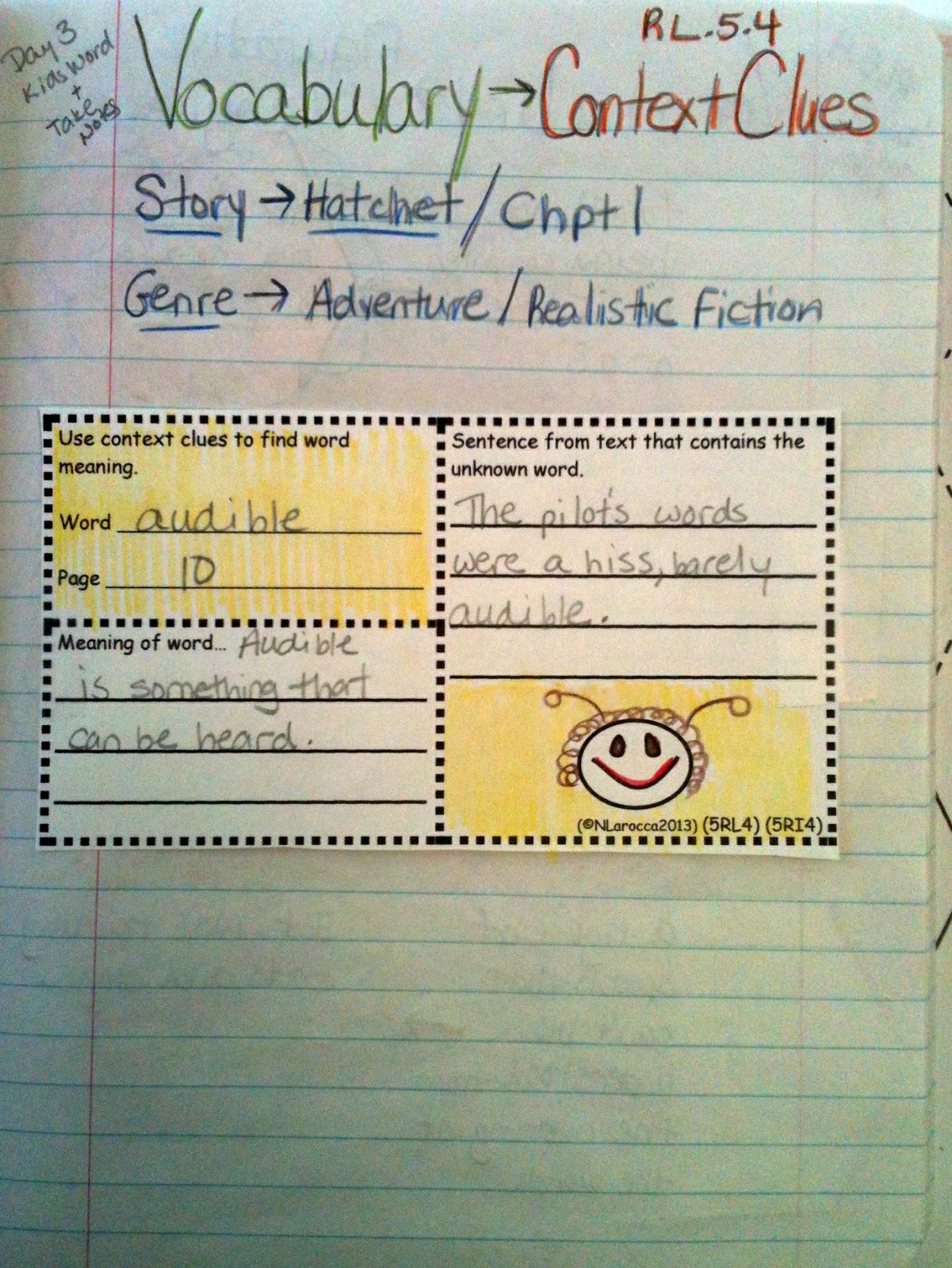
Day 2...Review what was read the day before and model how to use the strategy of context clues by reading the words around text. Complete the organizers together and glue or tape into your book. Finish reading chapter 1.


Day 3...Review the context clues strategy and have the students work with a partner to complete one on their own and glue into their book.


Day 3...Continue taking more notes on RL5.4 for figurative language. Students color the shapes, cut them out, and attach them to their book. I had them tape it on the side so they could fold them over and write the definition underneath. Also write an example of the type of figurative language and discuss its meaning.


Wednesday, July 3, 2013

Interactive Reader's Response Notebook and Journal RI.4.6

Last year I taught 4th grade and integrated an Interactive Readers Response Notebook and Journal into my classroom. I learned a lot about CCSS by doing this and it helped with classroom instruction and management. The following is an example of RI.4.6. We read two different articles about the toilet from Storyworks. The kids love gross stuff and this was perfect for them. Our goal was to compare and contrast two accounts of the same event/topic which was the disposal of human waste. Fun times in 4th grade...here goes.
This process takes time but it is so worth it. Students have a model to refer to and they use it to guide their own learning which is part of the common core. I hope this helps you. I highly recommend a subscription to Storyworks. They have text that is lexiled and written for 3rd-6th grade level. It helps me greatly because our reading series is old and I have not touched it in 10 years. Yikes!

I included the links below including a freebie to check out. Maybe this is something you can use. Please ask me questions if you need help. Also I'm new to blogging and this is a learning process for me. My blog is not beautiful and that is not my goal at this point.  My goal this year is to share what I do in my classroom, learn as an educator and teach to the best of my ability.

We took notes on compare and contrast and what good readers do when they use this strategy. We read one article and highlighted text. We did this together.
The next day we read the second text and highlighted information that was important. We completed a venn diagram together showing the similarities and differences in text.


The 3rd day we reviewed our venn diagram and discussed what we learned from this text and wrote the following information together.

http://www.teacherspayteachers.com/Product/Interactive-Readers-Response-Journal-or-Notebook-for-4th-and-5th-Grade-CCSS-473182

http://www.teacherspayteachers.com/Product/Interactive-Readers-Response-Journal-or-Notebook-for-5th-Grade-CCSS-747376

http://www.teacherspayteachers.com/Product/Interactive-Readers-Response-Journal-or-Notebook-for-4th-Grade-CCSS-747369

http://www.teacherspayteachers.com/Product/Interactive-Readers-Response-Journal-or-Notebook-4th-5th-Grade-Freebie-747384

Saturday, May 4, 2013

4NF1 - 4NF7 Vocabulary Center

This is vocabulary center that I created for my students to use as we covered the standard 4NF1 - 4NF7. There are various ways you could use it. I had my students rotate through it with a partner. They used their iPads to scan the QR codes to get the definitions, read them aloud, and placed the code behind the correct vocabulary word.  The link is below at TpT.


http://www.teacherspayteachers.com/Product/4th-Grade-Fraction-and-Decimal-Vocabulary-with-QR-Codes-Common-Core-4NF1-4NF7


Tuesday, April 30, 2013

4MD1 and Readers Response Notebook


This is an activity from my Measurement and Data Unit. It's a fun flip chart students make and use to help them with metric and customary conversions. I also began adding my graphic organizers to my readers response notebook. My students like using the organizer, cutting it out and adding it to their notebook versus just drawing a diagram.


http://www.teacherspayteachers.com/Product/4th-Grade-Measurement-and-Data-Assessment-Practice-or-Task-Cards-4MD1-4MD2

http://www.teacherspayteachers.com/Product/4th-Grade-Measurement-Worksheets-Activities-and-Center-Cards-4MD1-and-4MD2

http://www.teacherspayteachers.com/Product/4th-Grade-Common-Core-Literature-and-Informational-Text-Graphic-Organizers

Wednesday, April 17, 2013

4th Grade Common Core Vocabulary

This is my newest creation and it exposes students to many words they have learned through out the school year along with new words. Vocabulary is all about exposure and how many different ways students can learn about the words. These words are academic vocabulary from 4th grade Common Core ELA. Students are reviewing and learning new words by using their iPads and making flip charts. This is just one activity that is in the unit. The link below takes you to the product along with a freebie to try. I hope you can use it!

 http://www.teacherspayteachers.com/Product/4th-Grade-Common-Core-ELA-Vocabulary-Activities-and-Review


http://www.teacherspayteachers.com/Product/4th-Grade-Common-Core-ELA-Vocabulary-Activities-and-Review-Freebie

Sunday, March 17, 2013

4NF5 - What I did to teach it...

Students need to be able to express a fraction with a denominator of 10  as an equivalent fraction with a denominator of 100 and use this technique to add fractions.

This is what I did...

Lesson 1  First we created equivalent fractions with denominators of 10 and 100 by shading in base 10 blocks. Students looked at the shapes and realized that they were different in parts but equaled the same amount and were the same size.

Ex...3/10 = 30/100

Lesson 2  We continued this process reversing it from 100 to 10 and students did use the base ten blocks if necessary. Students were asked how to explain this process and they used the models or drew pictures of the models to explain their thinking. I also used money for some students-dimes and pennies.

Lesson 3 Next we moved on to adding fractions of 10 and 100 by using base ten models to create equivalent fractions. I spent 2 days on this concept and also reviewed this in small group. I also used money to help with this concept. Students also practiced subtration as well.

Ex...3/10 + 4/100 = 30/100 + 4/100 = 34/100

3/10- 4/100 = 30/100 - 4/100 = 26/100

Lesson 4  Students then took their knowledge and applied it to solve problems that involved this skill.

Center Activities I also created a matching game that involved addition with deominators of 10 and 100 and I used that in small group and whole group. Students would get a card and they would need to find their partner. Once everyone found their partner they spoke about their answer and how they knew it was correct.

I also created a matching game that involved money with dimes and pennies so that students related the concept to something else besides base ten models.

http://www.teacherspayteachers.com/Product/4th-Grade-Fraction-Worksheets-and-Center-Cards-Common-Core-4NF5

I hope this helps you!

Tuesday, March 5, 2013

4NF4 - What I did to teach it.

Students need to understand that fractions can be a multiple, how to multiply fractions, and solve word problem involving multiplication. This is the process I went through so that my students understood the standard. I listed the items in order as to what I taught.

Lesson 1 We decomposed frations and wrote them as multiplication expressions.

Ex: 2/5= 1/5 + 1/5...decompose the fraction first.  Ask the question...How many 5ths are there? Answer 2, therefore 2/5 is the same as 2 x 1/5.

Lesson 2 We wrote whole numbers as fractions and explained the concept of why it works with division. Students rewrote problems and then proceeded to multiply.

Ex. 3 x 1/4 = 3/1 x 1/4

3/1 is the same as 3 divided by 1 = 3

I showed models as well.

 Students solved several problems in which they rewrote the whole number as a fraction and multiplied to solve the equation.

Lesson 3 We created multiplication expressions to model multiples.

Ex: 2 x 3 = 6 x 1   therefore

2 x 3/4 = 6 x 1/4

Lesson 4 We created models of multiplication sentences.

Lesson 5 We practiced the multiplication algorithm.

Lesson 6 We practiced word problems.


Centers-I created flash cards with multiplication problems that students can solve. They also were required to create their own story problems using the cards and how to model the problems. They also created screen chomp videos that showed if they understood what they needed to do to solve these types of problems.
I will post my anchor posters when I have time. I hope this helps for those that are struggling with CCSS.

http://www.teacherspayteachers.com/Product/4th-Grade-Fraction-Worksheets-and-Center-Cards-Common-Core-4NF4-a-b-and-c