Pages

Saturday, July 26, 2014

Reading Strategy and Skill Posters

Keep the Focus on Learning while maintaining organization...


So this is my newest creation for the school year, but it's not just a pack of posters. I made this to give my students the visual aid they need to remember what reading strategy or skill we are working on for the week or maybe longer. To be honest, sometimes I need that visual aid to keep myself focused with everything that is going on in the classroom. So...my idea is to use these posters as a focus wall that shows my students, as well as anyone else that walks into my room, what we are learning in reading and L.A. I also plan to use the strategy posters at my guided reading station. I have a dry erase board at the front and back of my classroom and bought magnets from the Dollar Store that I plan to use to create my Focus Wall. That way I can use my Expo Markers to easily write any needed info. right under the header for the other subject areas such as grammar, vocabulary, title, genre, or spelling. Once it's written my students will have that constant reminder and I'll have it as well. This is an example of what it might look like. 

This focus wall shows the two pieces of text we will read that week, the genres of the text, the reading strategy of making predictions, vocabulary words and grammar. Below shows what some of the other posters look like and I also made them in three different colors.


I also made a set of posters that explain what readers do before, during, and after they read which I plan to use at the beginning of the year, and during shared and guided reading. Again, just another tool to help students remember and and a great reminder for myself as a teacher.


You can find this at the link below! I hope it helps you. Good luck this school year!
Good Readers Strategy and Skill Reading Posters

I also included another link for this product that was made with a different font.

Reading-Strategy-and-Skill-Posters-for-Guided-and-Shared-Reading-2650435

Saturday, May 24, 2014

New School Year

So the end of the school year is upon us, and while I pack and clean my room I begin to think about what I can do in preparation for next year. I always try to get a head start for the next school year, so I started making some new posters. I figure if I make them now, I won't be waiting in line to use the laminator at the beginning of the school year.

I have always been into sticky notes and find them quite useful during guided reading or any small group instruction. The poster shown below shows how I use "Think Marks". I have my students read independently and they write think marks on their sticky note. Sometimes I assign the think mark and sometimes they get free choice.

After students read and write their think marks on their sticky note, we share our ideas about the text. Sometimes we use the app Socrative to share our think marks and students vote on them as well. This also gives me a type of recorded formative assessment. I plan to make one more think marks poster and add a few other reading strategies and skills.

I hope you can use this!


Monday, April 14, 2014

Genre Unit for Fiction and Non Fiction

I created this unit to expose my students to various fiction and non-fiction books and text features. My students were exposed to over 30 different genres of books from realistic fiction, graphic novels, and fantasy to encyclopedias, periodicals, and biographies. This unit got them reading different genres and they had an opportunity to explore books they rarely looked at. It took work and effort, but overall I'm ecstatic about the results. They went on a genre sort, genre search which was like a scoot/scavenger hunt activity, completed activities in their interactive notebook, completed a compare/contrast activity, and took an assessment.

The students really enjoyed it!

This is the fiction flip book and part of the fiction sort activity.

This was a part of the fiction search/scavenger hunt. Students traveled from station to station looking at books and determined what genre each station contained based on illustrations, text features, and descriptions.

If you are interested I included the link for this unit below.


Genre Activities Sort and Search

Sunday, November 17, 2013

Interactive Notebook and Hatchet 5RL1, 5RL2, and 5RL4

So I finally have about 2 minutes to post and share some other ways I used my Interactive Notebook with the novel Hatchet. I used it to teach 5RL1, 5RL2, and 5RL4. These are all 5th grade standards. My students enjoyed the novel. I was able to cover every 5th grade standard for Reading Literature which is a huge relief and now I feel confident in continuing that instruction with partners and independent work for Literature. Yes!

Check it out! I modeled theme, making predictions and inferring, and making meaning of similes and metaphors in text.

http://www.teacherspayteachers.com/Product/Interactive-Readers-Response-Journal-or-Notebook-for-4th-and-5th-Grade-CCSS-473182


Tuesday, September 3, 2013

Interactive Reader's Response Notebook and Hatchet

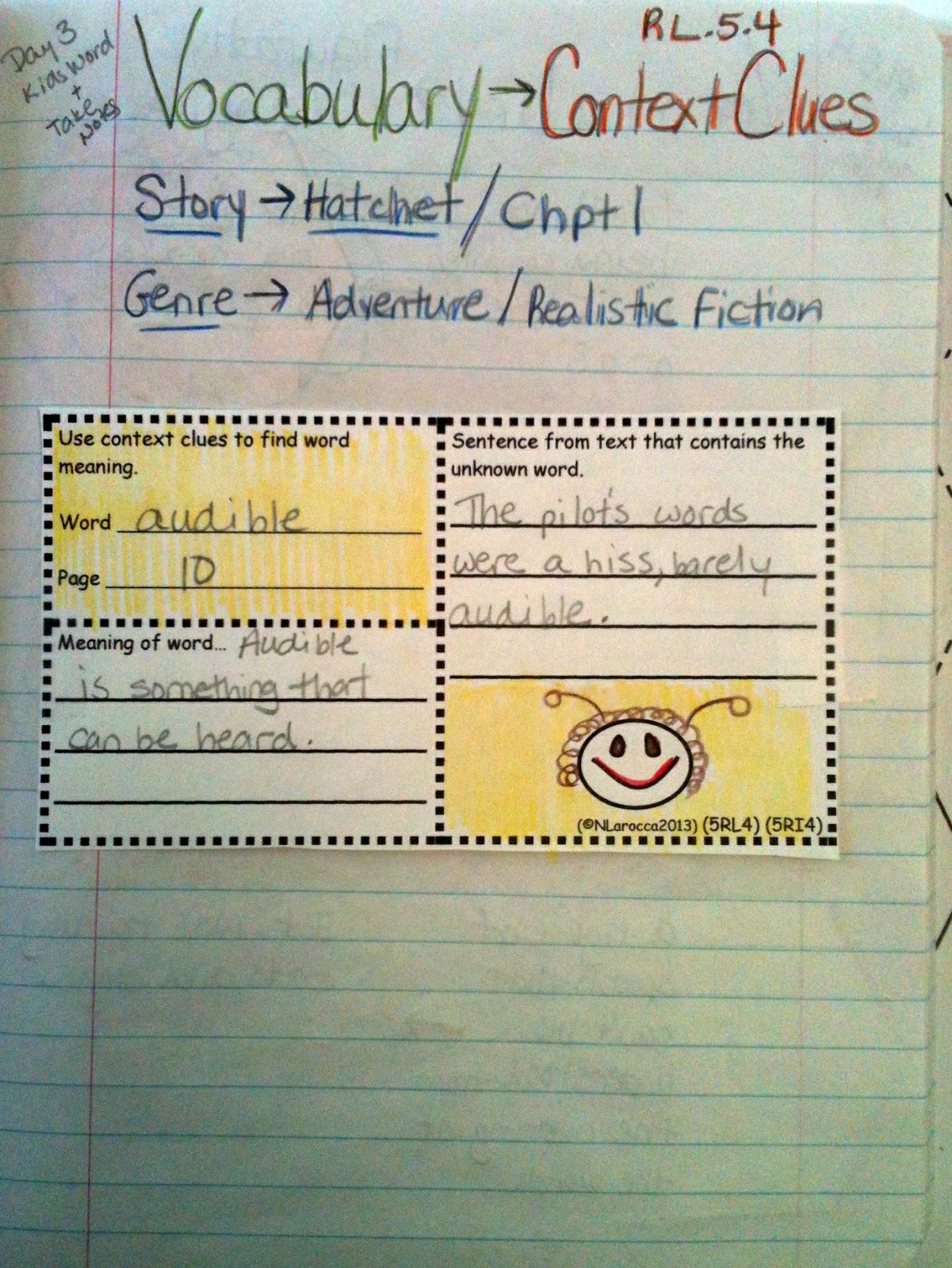
So this week I will begin incorporating my Interactive Notebook into the classroom and wanted to share a few of my first lessons. My students are going to begin reading the novel Hatchet, I hope, still waiting for the books to arrive. My fingers are crossed. So I began making a few lessons from the material found in my interactive notebook and this is what they look like. My interactive notebook is a resource you can use to guide your instruction of the 4th and 5th grade common core. Last year I taught 4th and I'm teaching 5th grade this year. You choose text and create your lessons based upon what strategies or common core standard you want to teach. I begin with vocab, and model what good readers do, read...read...read... and then model some more, partner work, and eventually then do it on their own. I also grouped 4th and 5th grade together because the material is similar. 4th grade teachers could use 5th grade material to extend and go beyond.

Day 1...Begin by taking notes of RL5.4 and what good readers do when they come to a word that they don't know. Read the first 6 pages and model the strategy aloud of stopping and figuring out the meaning of words using context clues or a source.


Day 2...Review what was read the day before and model how to use the strategy of context clues by reading the words around text. Complete the organizers together and glue or tape into your book. Finish reading chapter 1.


Day 3...Review the context clues strategy and have the students work with a partner to complete one on their own and glue into their book.


Day 3...Continue taking more notes on RL5.4 for figurative language. Students color the shapes, cut them out, and attach them to their book. I had them tape it on the side so they could fold them over and write the definition underneath. Also write an example of the type of figurative language and discuss its meaning.


Wednesday, July 3, 2013

Interactive Reader's Response Notebook and Journal RI.4.6

Last year I taught 4th grade and integrated an Interactive Readers Response Notebook and Journal into my classroom. I learned a lot about CCSS by doing this and it helped with classroom instruction and management. The following is an example of RI.4.6. We read two different articles about the toilet from Storyworks. The kids love gross stuff and this was perfect for them. Our goal was to compare and contrast two accounts of the same event/topic which was the disposal of human waste. Fun times in 4th grade...here goes.
This process takes time but it is so worth it. Students have a model to refer to and they use it to guide their own learning which is part of the common core. I hope this helps you. I highly recommend a subscription to Storyworks. They have text that is lexiled and written for 3rd-6th grade level. It helps me greatly because our reading series is old and I have not touched it in 10 years. Yikes!

I included the links below including a freebie to check out. Maybe this is something you can use. Please ask me questions if you need help. Also I'm new to blogging and this is a learning process for me. My blog is not beautiful and that is not my goal at this point.  My goal this year is to share what I do in my classroom, learn as an educator and teach to the best of my ability.

We took notes on compare and contrast and what good readers do when they use this strategy. We read one article and highlighted text. We did this together.
The next day we read the second text and highlighted information that was important. We completed a venn diagram together showing the similarities and differences in text.


The 3rd day we reviewed our venn diagram and discussed what we learned from this text and wrote the following information together.

http://www.teacherspayteachers.com/Product/Interactive-Readers-Response-Journal-or-Notebook-for-4th-and-5th-Grade-CCSS-473182

http://www.teacherspayteachers.com/Product/Interactive-Readers-Response-Journal-or-Notebook-for-5th-Grade-CCSS-747376

http://www.teacherspayteachers.com/Product/Interactive-Readers-Response-Journal-or-Notebook-for-4th-Grade-CCSS-747369

http://www.teacherspayteachers.com/Product/Interactive-Readers-Response-Journal-or-Notebook-4th-5th-Grade-Freebie-747384

Saturday, May 4, 2013

4NF1 - 4NF7 Vocabulary Center

This is vocabulary center that I created for my students to use as we covered the standard 4NF1 - 4NF7. There are various ways you could use it. I had my students rotate through it with a partner. They used their iPads to scan the QR codes to get the definitions, read them aloud, and placed the code behind the correct vocabulary word.  The link is below at TpT.


http://www.teacherspayteachers.com/Product/4th-Grade-Fraction-and-Decimal-Vocabulary-with-QR-Codes-Common-Core-4NF1-4NF7